
Ngu Hanh Son means “five element mountains.” The name promises more than the visit delivers if you take it literally, because only one of the five is developed. But that one mountain, full of caves and Buddhist shrines, is one of Da Nang's best half-days, and one of its cheapest. This is the complete version: what is in each cave, what you pay, and the details most guides skip.
The short answer
Main entrance
40,000 VND
Elevator
15,000 one-way / 30,000 return
Am Phu Cave (separate)
20,000 VND
Steps to the top
156, uneven stone
Hours
~7:00 AM - 5:30 PM
Time to allow
2 - 3 hours
What the Marble Mountains are
The Marble Mountains are five marble-and-limestone hills that rise out of the flat coastal plain south of central Da Nang, in the district that shares their Vietnamese name, Ngu Hanh Son. They were sacred to the Cham long before they were Buddhist. Today the developed one is a maze of natural caves turned into shrines, linked by stone staircases, with two clifftop platforms over the coast. In 2019 the whole site became a National Special Relic.
It is compact, a couple of hours of climbing and ducking into caves, not a sprawling park, and it sits about ten minutes from the airport. That is why it turns up on so many arrival-day and layover plans.
The five mountains, and why you climb only one
Emperor Minh Mang named the cluster in the early 1800s, giving each hill one of the five elements: Kim Son (metal), Moc Son (wood), Thuy Son (water), Hoa Son (fire), and Tho Son (earth). It is a tidy piece of five-element cosmology, and a source of confusion, because visitors often arrive expecting to explore all five.
In practice, only Thuy Son is developed. It is the largest and tallest of the five (about 106 metres, with three summit points), and it holds everything people mean by visiting the Marble Mountains: the caves, the pagodas, the lift, the ticket booth, and the viewpoints. The other four are mostly bare hillside with a few small shrines at their bases and no trail network. So there is no need to plan around all five. Everything below is Thuy Son.
History: Cham shrines, Nguyen emperors, and a wartime hospital
The caves were places of worship for the Cham centuries before they became Buddhist temples. Cham and Hindu carvings survive in some of the grottoes, and a statue of the Cham goddess Thien Y A Na still sits in Hoa Nghiem cave. Under the Nguyen dynasty in the 1820s and 30s, Emperor Minh Mang named the mountains, had pagodas built and rebuilt, and gave several caves the names they still carry.
The most striking history is recent. During the war, the largest cave, Huyen Khong, was a secret base and field hospital for liberation fighters, and it was bombed in 1968. That layered past, Cham shrine, imperial Buddhist site, wartime refuge, is part of what makes the place more than a photo stop. It is also why the marble-carving tradition at the foot of the mountains, brought here in the late 1600s, is treated as living heritage rather than a souvenir gimmick.
The caves, the real reason to come
The pagodas are pleasant; the caves are the point. Thuy Son holds around nine of them, from a cathedral-sized chamber to squeezes you climb through single file. These are the ones worth knowing.
Huyen Khong: the one to prioritise
The largest and most atmospheric cavern on the mountain, and the one repeat visitors call the highlight. Five openings in the roof, said locally to stand for the five fingers of Buddha's hand, let sunlight fall about 30 metres down onto the altar and a roughly four-metre white Sakyamuni Buddha, carved by a Non Nuoc craftsman in 1960. The light beams are strongest late morning to midday, when the sun is overhead and the shafts catch the incense smoke; under heavy cloud the effect disappears. It is cool and naturally ventilated inside, and it is the cave that served as a field hospital during the war.
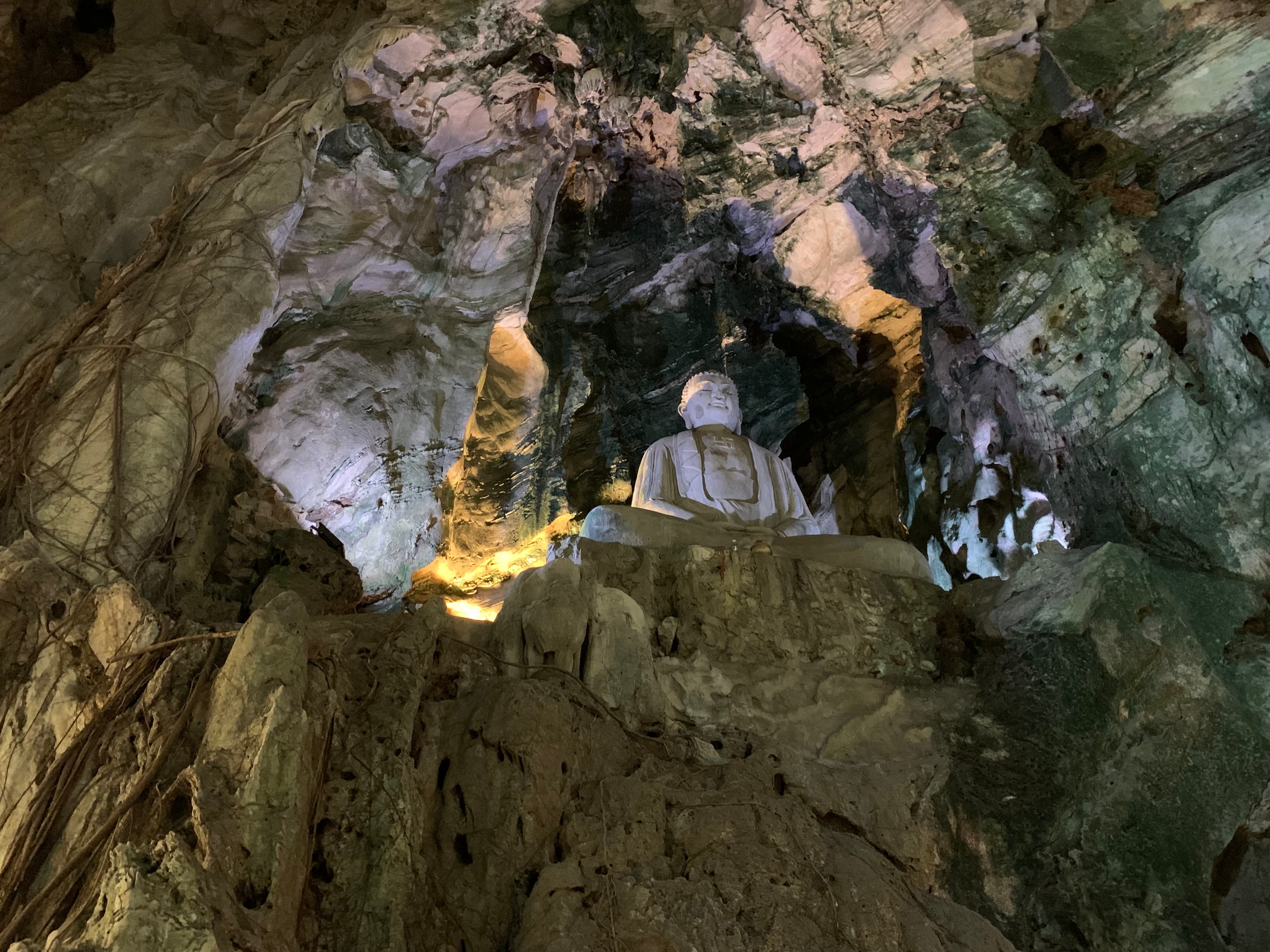
Am Phu (Hell) Cave: the theatrical one, separate ticket
A separate, ground-level cave near the base, on its own 20,000 VND ticket. A corridor of about 300 to 350 metres recreates the 18 levels of Buddhist hell in stone. A descending path to hell passes scenes of punishment, with Dia Tang, the Earth-Store Bodhisattva, at the centre. A steep path to heaven climbs to a skylight and a view over Non Nuoc Beach. It is theatrical rather than frightening, stays cool year-round, and was built as the dark counterpart to the mountain's pagodas.
Tang Chon, Van Thong, and Linh Nham: the smaller caves
Tang Chon, behind Linh Ung pagoda, is easy to miss, you duck under a low arch into a quiet temple grotto where the mountain's first monks are said to have lived. Van Thongis the “stairway to heaven”: a narrow tunnel, single file in places, that you climb through a tight opening to reach the summit rock. Skip it if you are claustrophobic or unsteady. Linh Nhamis a tiny grotto behind Tam Thai's yard, a quick single-altar stop. Worth a look with time to spare, skippable without.
Pagodas and the Xa Loi tower
Tam Thai Pagoda
The main temple on Thuy Son. A stele records an original build date of 1630, with a rebuild under Minh Mang in the 1820s and 30s. It has blue walls and a dragon roof, set in a garden over the coast. Visitors pair this and Huyen Khong cave as the two stops to prioritise if time is short.
Linh Ung Pagoda
Built in 1825, and the oldest of Da Nang's three Linh Ung pagodas (more on that mix-up below). Small and quiet, and often overlooked in favour of the caves right beside it.
Xa Loi (Bao Thap) Tower
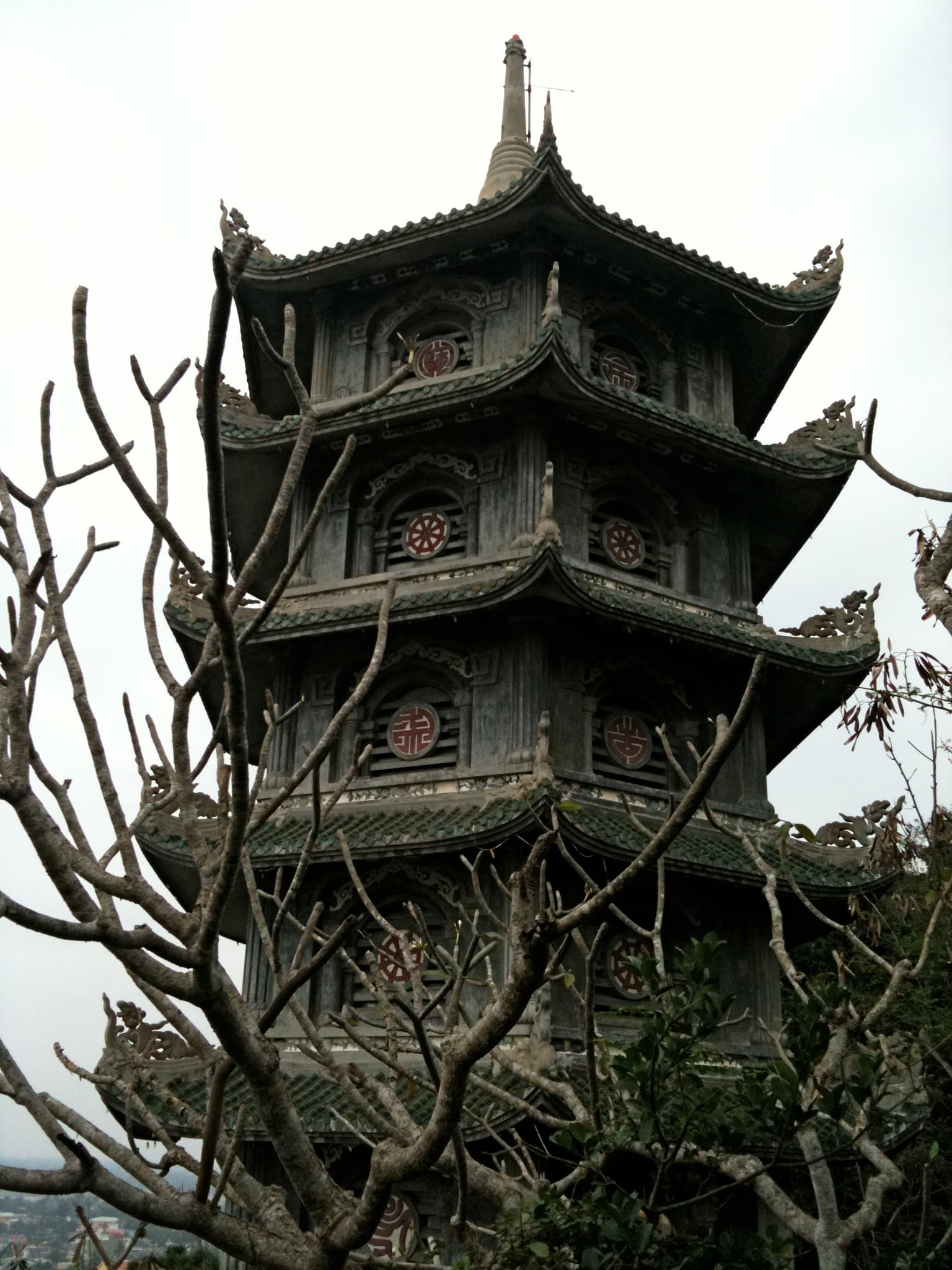
The tallest structure on the mountain: a seven-storey hexagonal tower about 28 metres high, built in 1997 near the top of the elevator. Its seven levels echo the seven steps the Buddha is said to have taken at birth, and it holds around 200 stone statues, reportedly the most of any tower in Vietnam.
The two viewpoints
Two clifftop platforms face opposite directions, and they are easy to confuse, since both are just “the viewpoint” in casual talk. Vong Hai Dai (the sea-watching tower) looks out over Non Nuoc Beach and the sea. Vong Giang Dai (the river-watching tower) faces inland over the rivers, the marble village, and the city. Between them you get both the coast and the countryside, worth the few extra steps on a clear morning.
Elevator or the 156 steps?
The free stone staircase is 156 steps, worn smooth and uneven in places, about 5 to 10 minutes of climbing. The elevator (15,000 VND one-way, 30,000 VND round-trip) takes you to the main pagoda level in about a minute. But it only removes the first climb. From there, the caves, viewpoints, and inner temples are still reached on foot up more stairs. The lift can also close in storms.
| Elevator | 156 steps | |
|---|---|---|
| Price | 15,000 VND one-way / 30,000 return | Free (in the 40,000 VND entry) |
| Effort | Minimal | Steep, uneven, slippery when wet |
| Reaches | Main pagoda level only | The whole developed area on foot |
| Best for | Heat, limited mobility, midday | Cooler hours, able walkers, the full experience |
The common compromise: lift up, stairs down. You climb in one direction only, and still pass the temples and caves on the way down.
Tickets, hours, and the dress code
There is no combined ticket. It is a few separate purchases, and the total per person is usually about 55,000 to 90,000 VND, depending on whether you add the elevator and Am Phu Cave.
| Price (2026) | Notes | |
|---|---|---|
| Main entrance (Thuy Son) | 40,000 VND | The core ticket; consistent across 2026 sources |
| Elevator, one-way | 15,000 VND | Optional |
| Elevator, round-trip | 30,000 VND | Optional |
| Am Phu (Hell) Cave | 20,000 VND | Separate ticket, at the base |
| Opening hours | ~7:00 AM - 5:30 PM | Last entry ~4:30 PM; elevator stops ~5:00 PM |
Cash is the safe assumption at the booths, and the site operator can change prices by season. Official child, student, and senior rates are not reliably published online, so check at the booth rather than trusting a figure from a blog.
Dress code, worth knowing before you go
This is an active Buddhist site with working temples, so cover your shoulders and knees at the shrines. You will not be stopped at the gate for beach clothes, but you will feel out of place at the altars, and covering up also helps with the sun on the exposed top. Wear closed shoes with grip. Flip-flops on wet marble steps are a real way to get hurt.
Do not mix this up: the Lady Buddha
There are three pagodas named Linh Ung in Da Nang, and the Marble Mountains have the oldest, smallest, and quietest of them (1825). The famous one, the 67-metre Lady Buddha statue most people picture, is a separate, much larger site on the Son Tra Peninsula (Monkey Mountain), about 20 minutes away on the coast. If a photo of a giant white Buddha is why you are coming, you want Son Tra, not here.
Non Nuoc marble-carving village
At the foot of the mountains sits the village the whole site is named for. Around 500 stone-carving workshops line its lanes. The craft was brought here from Thanh Hoa in the late 1600s, and in 2014 it became the first thing in Da Nang recognised as National Intangible Cultural Heritage. You can hear the chisels before you see the showrooms, which sell everything from palm-sized Buddhas to full statues. It is free to walk through and pairs naturally with the mountain rather than being a separate trip. Two honest notes: much of the raw marble is now imported, because quarrying the mountains is restricted to protect them, and the shop staff can be pushy about a sale, more so later in the day than at opening.
Planning the visit
The mountains are compact and easy to fold into a bigger day. They sit right on the road to Hoi An and about ten minutes from the airport, so they pair naturally with an arrival day, a long layover, or a Hoi An day trip rather than a trip of their own.
- Arrive by 7:30 to 8 AM if you can. Tour buses cluster from about 9:30 AM, and mornings are cooler for the climb.
- Dress modestly for the temples (shoulders and knees), and wear closed shoes with grip, not sandals.
- Bring small cash for the separate ticket booths.
- Give Huyen Khong cave time. It is the highlight, and the light beams peak late morning.
- It is about 10 minutes from Da Nang airport, 15 to 20 from the city centre, and right on the road to Hoi An.
Before you climb
You cannot do 156 steps with a suitcase. Leave it in the city first.
In the same district
Ngu Hanh Son
By the hour
15,000 VND/hr
Full day
60,000 VND (up to 24h)
New to Stow? See how luggage storage in Da Nang works.
Questions people ask
How much does it cost to visit the Marble Mountains?
Entry to Thuy Son, the one developed mountain, is 40,000 VND per person. The elevator is optional at 15,000 VND one-way or 30,000 VND round-trip. Am Phu (Hell) Cave is a separate 20,000 VND ticket at the base. Doing all three comes to about 90,000 VND, roughly US$3.60, which is why it is one of Da Nang's best-value half-days.
Is there an elevator, or do I have to climb the steps?
Both exist. There are 156 stone steps to the top of Thuy Son, or a lift (15,000 VND one-way, 30,000 VND round-trip) to the main pagoda level. Beyond that level, the caves and viewpoints are reached on foot up more steps. The lift removes the first climb, not all of them.
How long do you need at the Marble Mountains?
About 2 to 3 hours covers Thuy Son well: the caves, the two main pagodas, the viewpoints, and the Xa Loi tower. Add about 30 to 45 minutes for Am Phu Cave at the base. It is a half-day trip, not a full day, so plan something else for the afternoon.
What is the best time of day to go?
Early, ideally 7:00 to 8:30 AM, for cool air, quiet paths, and empty caves. Tour buses cluster from about 9:30 AM, and the midday heat on the exposed top is real. The one trade-off: the light beams in Huyen Khong Cave are strongest late morning to midday, when the sun is overhead. If they matter to you, arrive early and wait in the cave for the light.
Is there a dress code for the Marble Mountains?
It is an active Buddhist site with working temples, so cover your shoulders and knees at the shrines. You will not be turned away at the gate for beach clothes, but you will feel out of place at the altars, and covering up also helps with the sun. Wear closed shoes with grip. The stone steps are uneven and slippery when wet.
Is the Lady Buddha statue at the Marble Mountains?
No. This is the most common mix-up. The giant 67-metre Lady Buddha statue is at a different Linh Ung Pagoda on the Son Tra Peninsula, about 20 minutes away on the coast. The Marble Mountains have their own, much older and smaller Linh Ung Pagoda, built in 1825. If a photo of a huge white statue is why you are coming, you want Son Tra, not here.
Are the Marble Mountains accessible for wheelchairs or older visitors?
Only partly. The elevator reaches the main pagoda level, but beyond it the temples, caves, and viewpoints are stairs only, with no ramps, and the stone is uneven and slippery when wet. It is not wheelchair accessible. If mobility is a concern, take the lift up, keep to the top pagodas and gardens, and skip the tight Van Thong squeeze and the steeper cave routes.
What is Am Phu (Hell) Cave, and is it scary?
It is a separate ground-level cave on its own 20,000 VND ticket that recreates the 18 levels of Buddhist hell in stone. A descending path to hell passes scenes of punishment; an ascending path to heaven climbs to a viewpoint over the coast. It is theatrical rather than frightening, and plenty of families do it. The inside stays cool year-round.
How do I get to the Marble Mountains from Da Nang, the airport, or Hoi An?
It is about 8 km and 10 to 15 minutes from Da Nang airport, roughly 9 km and 15 to 20 minutes from the city centre (a Grab is about 80,000 to 120,000 VND), and about 20 to 25 km and 25 to 30 minutes from Hoi An. So it fits neatly onto a Da Nang to Hoi An day. Grab, Xanh SM, and Maxim all work locally.
Are all five Marble Mountains open to visit?
No. Only Thuy Son (Water Mountain), the largest, is developed with steps, a lift, caves, and pagodas. It is what almost everyone means by visiting the Marble Mountains. The other four (Kim, Moc, Hoa, and Tho) are mostly bare hillside with a few small shrines at their bases and no trail network, so plan around Thuy Son.
Sources
- 1.Wikipedia: Ngu Hanh Son · the five element peaks, the 156 steps, only Thuy Son being open, and the 2019 National Special Relic status
- 2.VietnamNet: Five Element Mountains · the element names and Emperor Minh Mang's early-19th-century naming of the cluster
- 3.Vietnam Law Magazine: Ngu Hanh Son · Thuy Son's dimensions and summit points, and the site's Cham heritage
- 4.Official Ngu Hanh Son tourist-area site · the site operator's own overview and cave descriptions
- 5.VinWonders: Huyen Khong and Am Phu caves · the skylights, the 1960 Sakyamuni statue, the 1968 field-hospital history, and Am Phu Cave detail
- 6.Da Nang Government Portal: Non Nuoc heritage · the 2014 National Intangible Cultural Heritage recognition of the Non Nuoc stone-carving village
- 7.Jungle Boss Tours: Marble Mountains 2026 guide · current 2026 ticket prices, opening hours, and elevator times
- 8.Hoi An Day Trip: Marble Mountains tickets · the 2026 ticket breakdown and the Am Phu Cave separate fee
The site operator sets hours and ticket prices, and they can change by season. Worth a quick check on the day if you are planning tightly around them.